
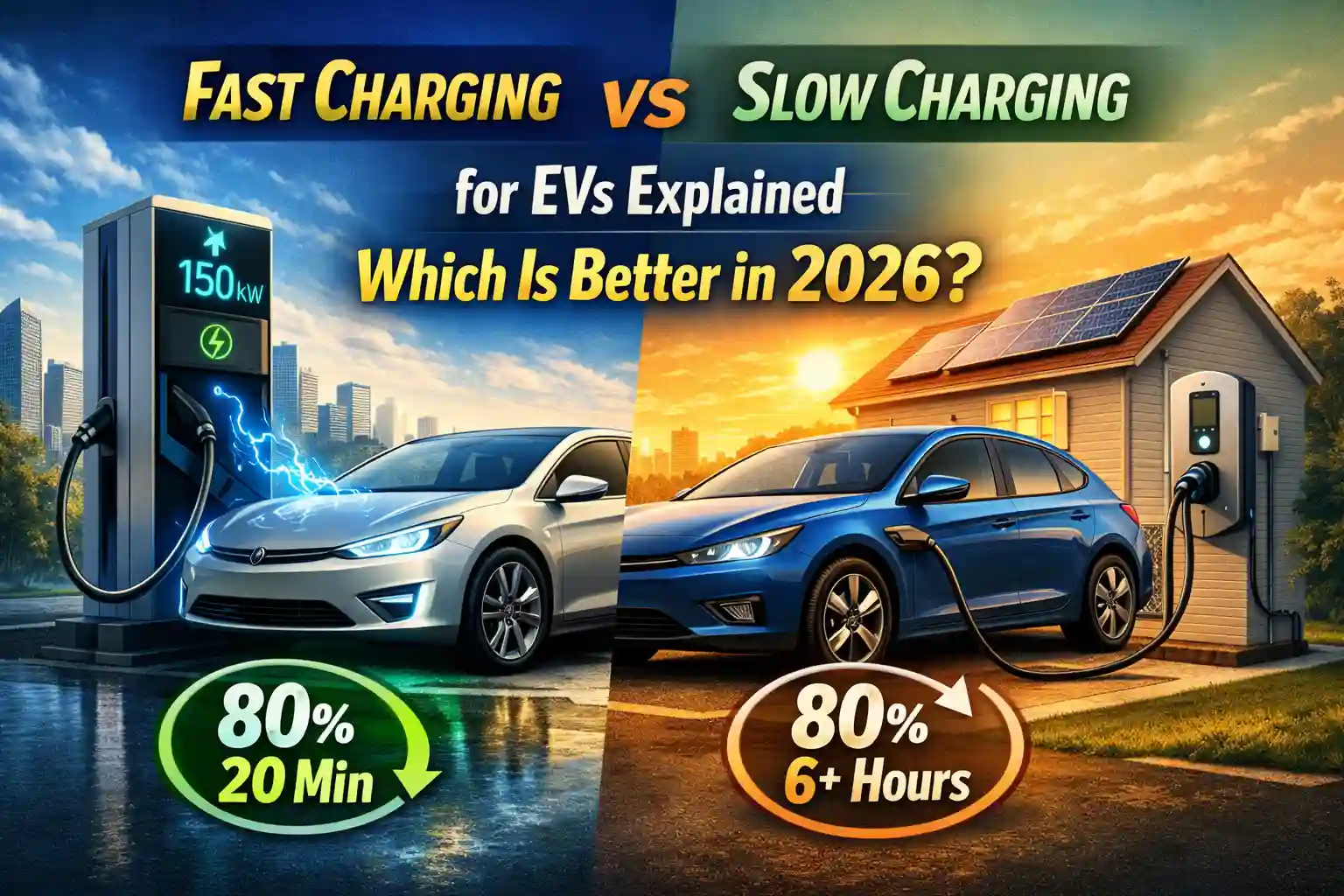
Fast Charging vs Slow Charging for EVs Explained – Which Is Better in 2026?
Electric vehicles are growing rapidly in 2026 as fuel prices increase and governments promote clean energy transportation. One of the most searched questions today is: Fast Charging vs Slow Charging for EVs – which is better in 2026?
If you are planning to buy an electric vehicle or already own one, understanding the difference between charging methods is very important. Charging speed affects battery health, cost, long term performance, and daily convenience. This detailed guide explains everything in simple English so you can make the right decision.
What Is Slow Charging for EVs in 2026?
Slow charging usually refers to Level 1 or Level 2 AC charging. This method uses alternating current to charge the battery gradually.
Types of Slow Charging
Level 1 Charging
- Uses a standard household socket
- Very slow charging speed
- Suitable for emergency use
Level 2 Charging
- Uses a dedicated wall mounted charger
- Installed at homes, apartments, or offices
- Faster than Level 1 but still considered slow compared to DC fast charging
Charging Time
- Level 1 may take 20 to 30 hours for a full charge
- Level 2 usually takes 6 to 12 hours
Most EV owners prefer Level 2 charging at home because it allows overnight charging.
What Is Fast Charging for EVs in 2026?
Fast charging is also called DC fast charging or rapid charging. It uses direct current to send high power directly to the battery.
Unlike slow charging, fast charging stations convert electricity outside the car, allowing much faster energy transfer.
Charging Speed
- 20 to 40 minutes to reach 80 percent battery
- Adds 100 to 250 miles of range in under 30 minutes depending on vehicle model
Fast charging stations are mostly located on highways, commercial areas, and city centers.
Fast Charging vs Slow Charging for EVs – Main Differences in 2026
1. Charging Speed
Fast charging is significantly quicker. It is ideal for long trips or urgent situations. Slow charging is better for daily routine charging.
2. Cost Per Charge
Slow charging at home is cheaper because you pay normal electricity rates.
Fast charging stations are more expensive due to infrastructure, maintenance, and service fees.
3. Installation Cost
Level 2 home chargers are affordable and easy to install.
Home DC fast chargers are very expensive and require special power systems, so they are rarely installed in houses.
4. Battery Health
Slow charging is better for long term battery health because it generates less heat.
Fast charging produces more heat due to high current flow. Although modern electric vehicles have advanced battery management systems, frequent fast charging can increase battery wear over time.
Manufacturers like Tesla, BYD, Hyundai, BMW, and Nissan design batteries with protection systems to manage heat and reduce damage.
5. Convenience
Slow charging is convenient for overnight home use. Fast charging is convenient for travel and commercial drivers who cannot wait several hours.

How Fast Charging Affects EV Battery Life in 2026
One of the biggest concerns people search for is whether fast charging damages EV batteries.
Modern EV batteries use lithium ion technology. These batteries are sensitive to heat and high charging speeds.
When you use DC fast charging frequently:
- The battery temperature increases
- Internal chemical stress rises
- Long term degradation may slightly increase
However, modern EVs now include:
- Thermal management systems
- Smart battery control software
- Automatic charging speed reduction above 80 percent
- Cooling systems
In 2026, occasional fast charging is considered safe. Experts recommend using slow charging for regular daily use and fast charging only when necessary.

Which Is More Affordable in 2026?
Cost is an important factor for most EV owners.
Slow Charging Cost
Charging at home during off peak hours is the most affordable option. Electricity tariffs at night are often lower in many countries.
Fast Charging Cost
Public fast charging stations charge higher per kWh rates. Some stations also include service or connection fees.
If you rely mainly on fast charging, your yearly charging expense will be significantly higher.
For budget conscious drivers, slow charging is clearly the better financial choice.
When Should You Use Fast Charging?
Fast charging is ideal for:
- Long distance road trips
- Highway travel
- Emergency low battery situations
- Taxi and ride sharing drivers
- Delivery services
If you travel more than 200 to 300 kilometers in one day, fast charging becomes necessary.
When Is Slow Charging the Better Option?
Slow charging is better for:
- Daily city driving
- Office commuters
- Overnight home charging
- Long term battery protection
- Reducing electricity costs
Studies show that most drivers travel less than 50 kilometers daily. For such users, slow charging is more than enough.
EV Charging Technology Improvements in 2026
Charging technology continues to improve each year.
Automakers such as Volkswagen and Ford are investing in:
- Ultra fast 350 kW chargers
- Improved battery cooling systems
- Smart charging software
- Solid state battery research
- Vehicle to grid systems
Although charging speeds are increasing, balanced usage remains important for long term battery performance.
Fast Charging vs Slow Charging for EVs – Which Is Better in 2026?
There is no single answer because it depends on your driving habits.
If you drive short distances daily and have access to home charging, slow charging is better.
If you travel frequently or depend on your vehicle for commercial use, fast charging becomes important.
For most EV owners in 2026, the best strategy is:
- Use slow charging for daily routine
- Use fast charging for travel and urgent needs
This combination provides the best balance between cost, battery health, and convenience.
FAQs – Fast Charging vs Slow Charging for EVs in 2026
1. Does fast charging reduce EV battery life?
Frequent fast charging may slightly increase battery wear over many years. However, modern EVs include protection systems to minimize damage.
2. Is slow charging better for battery health?
Yes. Slow charging generates less heat and supports longer battery life.
3. How long does fast charging take in 2026?
Most fast chargers can charge up to 80 percent in 20 to 40 minutes depending on the vehicle.
4. Can I fast charge every day?
It is possible, but experts recommend using slow charging as your primary method and fast charging occasionally.
5. Which charging method is cheaper?
Slow charging at home is generally cheaper than public fast charging.
Final Conclusion
In 2026, both fast charging and slow charging play important roles in electric vehicle ownership. Fast charging provides speed and flexibility for long journeys. Slow charging offers lower costs and better battery protection.
The smartest approach is not choosing one over the other. Instead, combine both based on your driving needs. This balanced method ensures better performance, longer battery life, and controlled charging costs.