
FIA Arrests NADRA Officials Over Fake IDs for Afghan Nationals: Major Crackdown on Fake Identity Documents in Pakistan
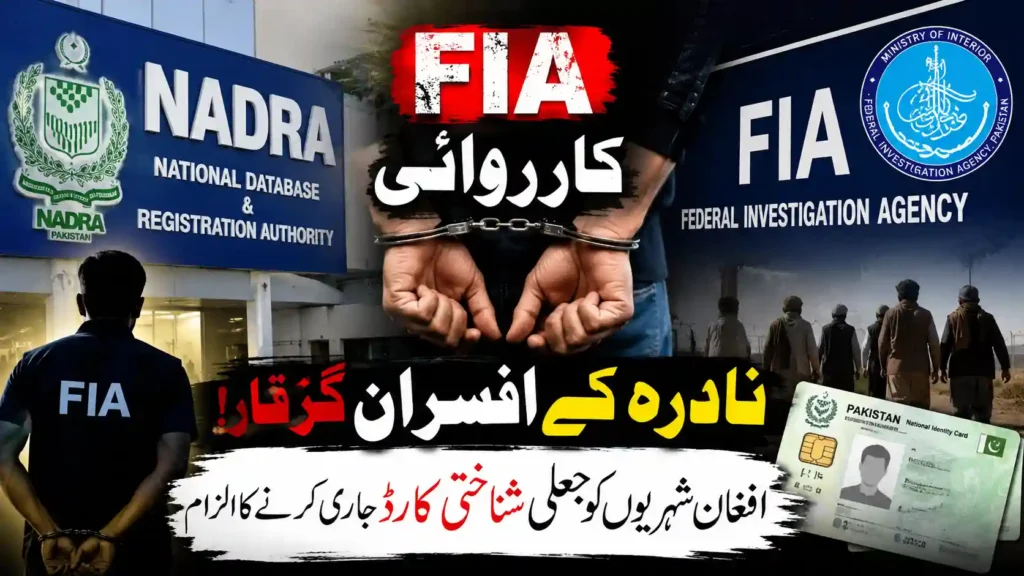
Pakistan’s law enforcement agencies have launched another major operation against the illegal issuance of national identity documents after the Federal Investigation Agency (FIA) arrested four suspects, including senior NADRA officials, for their alleged involvement in preparing fake identity documents for Afghan nationals.
The operation highlights the government’s ongoing efforts to strengthen the country’s identity registration system and eliminate networks involved in document fraud.
According to official statements, the suspects were arrested during a joint operation conducted in Karachi. Authorities believe the network had been facilitating the preparation of fraudulent Pakistani identity documents for Afghan citizens through manipulation of official records and other illegal means.
The latest development comes amid Pakistan’s broader campaign against illegal immigration, fake documentation, and identity fraud, particularly involving undocumented foreign nationals.
FIA Conducts Joint Operation Against Fake Identity Document Network
The Federal Investigation Agency (FIA) confirmed that the arrests were made during a coordinated operation with other law enforcement agencies. Officials recovered important documentary evidence, digital records, and other material believed to be linked to the alleged fake documentation network.
Investigators stated that the evidence collected during the raid will help identify additional suspects who may have assisted the group.
Authorities also revealed that the investigation has now been expanded, and further arrests are expected in the coming days.

Four Suspects Arrested During Karachi Operation
According to the FIA spokesperson, the following individuals were taken into custody:
- Imamul Haq (Inamul Haq) – Assistant Director, NADRA
- Fayyaz Ahmed – Deputy Assistant Director, NADRA
- Junaid Ahmed – Watchman working at NADRA
- Muhammad Umar Shah – Private agent
Officials believe each suspect played a different role in facilitating fraudulent documentation and manipulating official identity records.
Law enforcement agencies are currently examining electronic devices, official files, and other evidence seized during the operation.

Preliminary Investigation Reveals Serious Allegations
Initial findings from the investigation suggest that the suspects were allegedly involved in:
- Preparing fake Pakistani identity documents.
- Facilitating Afghan nationals in obtaining fraudulent documentation.
- Altering official records.
- Assisting illegal registration processes.
- Working with private agents to process fake applications.
The FIA stated that investigators are examining every document processed by the suspects to determine the full scale of the alleged fraud.
Officials say the investigation is still in its early stages, and additional evidence is being collected.

FIA Investigating Possible Links with Criminal and Terror Networks
One of the most significant aspects of the investigation is the possibility of connections between the alleged fake documentation network and terrorist elements.
According to the FIA spokesperson, preliminary evidence indicates possible links that are currently being investigated thoroughly.
Authorities clarified that no final conclusions have been reached, and investigators are continuing to examine all available evidence before making further announcements.
If such links are established, the case could become one of the most important identity fraud investigations in recent years.

Records and Evidence Seized During Operation
During the raid, investigators reportedly recovered:
- Official registration records
- Identity verification files
- Digital databases
- Supporting documentation
- Electronic evidence
The seized material is expected to help investigators identify additional beneficiaries of the alleged fake identity document scheme.
Officials have not disclosed the number of fraudulent documents that may have been issued.
Investigation Expanded as More Arrests Expected
The FIA has confirmed that the investigation is no longer limited to the four arrested suspects.
Officials believe additional facilitators may have been involved, including middlemen, private agents, and other individuals who allegedly assisted in processing fraudulent applications.
According to investigators, everyone connected to the network will be identified and prosecuted if evidence confirms their involvement.
Authorities have urged citizens to report suspicious activities related to fake identity documents.
Family of NADRA Official Reported Him Missing
The case gained additional attention after reports emerged that the family of one arrested official, Fayyaz Ahmed, had approached police claiming he was missing.
The family reportedly filed an application seeking his recovery before authorities officially confirmed his arrest.
The incident also attracted the attention of the Human Rights Commission of Pakistan (HRCP), which urged the Sindh government to ensure transparency regarding the whereabouts of the missing official before the FIA publicly announced the arrests.
Following the official statement, the mystery surrounding his disappearance was resolved.
Previous Cases of Fake CNICs for Afghan Nationals
The latest arrests are not an isolated incident.
Earlier this month, the FIA arrested three NADRA officials in Chakwal over allegations of issuing a Computerised National Identity Card (CNIC) to an Afghan national currently serving time in prison.
Similarly, another NADRA official was arrested in Karachi earlier this year on allegations of issuing fake identity cards to Afghan nationals.
These repeated cases have increased concerns regarding internal corruption within the country’s identity registration system.
Authorities are now reviewing previous identity verification records to detect additional irregularities.
Pakistan Intensifies Action Against Illegal Immigration
Pakistan has been implementing stricter immigration enforcement measures over the past year.
Millions of Afghan nationals have entered Pakistan during different periods over the last four decades due to regional conflicts and instability.
Following recent government directives, authorities have accelerated the identification and repatriation of undocumented foreign nationals residing illegally in the country.
In June, fresh instructions were issued directing law enforcement agencies to take action against undocumented Afghan nationals and strengthen verification procedures for identity documentation.
Officials say preventing fake documentation has become an important part of national security efforts.
Why Fake Identity Documents Are a Serious Concern
The issuance of fraudulent identity documents creates multiple security and administrative challenges.
Fake documents can potentially be used for:
- Illegal employment
- Financial fraud
- Passport applications
- Property transactions
- Bank account opening
- Criminal activities
- Cross-border movement
Authorities believe maintaining the integrity of Pakistan’s national identity database is essential for protecting public security and ensuring accurate population records.
Role of NADRA in Pakistan
The National Database and Registration Authority (NADRA) is responsible for:
- Issuing Computerised National Identity Cards (CNICs)
- Maintaining Pakistan’s citizen database
- Registering births and family records
- Issuing identity-related certificates
- Supporting government verification systems
Because NADRA manages sensitive national data, officials involved in illegal activities face serious legal consequences if found guilty.
The agency has repeatedly stated that it maintains zero tolerance for corruption and cooperates fully with law enforcement investigations.
Government’s Focus on Identity Verification
Pakistan has significantly strengthened its identity verification procedures over recent years.
Several measures have been introduced to improve transparency, including:
- Biometric verification
- Digital record monitoring
- Enhanced background verification
- Internal audits
- Cross-department coordination
- Strict employee accountability
Authorities believe these reforms will help reduce opportunities for identity fraud.
Public Reaction to the Arrests
The arrests have generated widespread discussion across Pakistan.
Many citizens have welcomed the FIA’s action, viewing it as an important step toward eliminating corruption within public institutions.
Others have called for broader reforms to ensure stronger oversight of identity registration processes and greater accountability for officials found guilty of misconduct.
Security analysts believe continued investigations could uncover larger networks involved in fake documentation.
What Happens Next?
Investigators are expected to:
- Examine seized digital records.
- Verify previously issued identity documents.
- Question additional suspects.
- Identify beneficiaries of the alleged fake documentation scheme.
- Determine whether wider criminal networks were involved.
The FIA has reiterated that investigations remain ongoing and that anyone connected to the alleged network will face legal action if evidence supports prosecution.
Officials have also indicated that more significant revelations may emerge as investigators analyze the evidence collected during the operation.
Conclusion About NADRA Officials
The arrest of four suspects, including NADRA officials, marks another significant development in Pakistan’s efforts to combat fake identity documents, identity fraud, and illegal registration practices involving Afghan nationals. As the Federal Investigation Agency (FIA) continues its investigation, authorities are working to identify all individuals linked to the alleged network and strengthen safeguards within the national identity registration system.
The outcome of this investigation could have important implications for future identity verification policies, institutional accountability, and Pakistan’s broader campaign against document fraud and illegal immigration.