Pakistan Fuel Price Update – Petrol Up by Rs. 3.66, Diesel Up by Rs. 4.80
The Government of Pakistan has announced a fresh Pakistan Fuel Price Update, bringing another increase in the prices of petrol and high-speed diesel (HSD). According to the latest notification issued by the Ministry of Energy (Petroleum Division) on 24 July 2026, the revised prices will come into effect from 25 July 2026.
The notification states that the revision has been made under the revised petroleum pricing mechanism, based on recommendations from the Oil and Gas Regulatory Authority (OGRA). This latest increase will directly affect millions of consumers, transporters, businesses, industries, and farmers across Pakistan.
In this article, you will find complete details of the latest Pakistan Fuel Price Update, revised petrol and diesel prices, official notification details, reasons behind the increase, expected economic impact, and answers to frequently asked questions.
Latest Pakistan Fuel Price Update July 2026
The federal government has approved an increase in both Motor Spirit (Petrol) and High-Speed Diesel (HSD) prices.
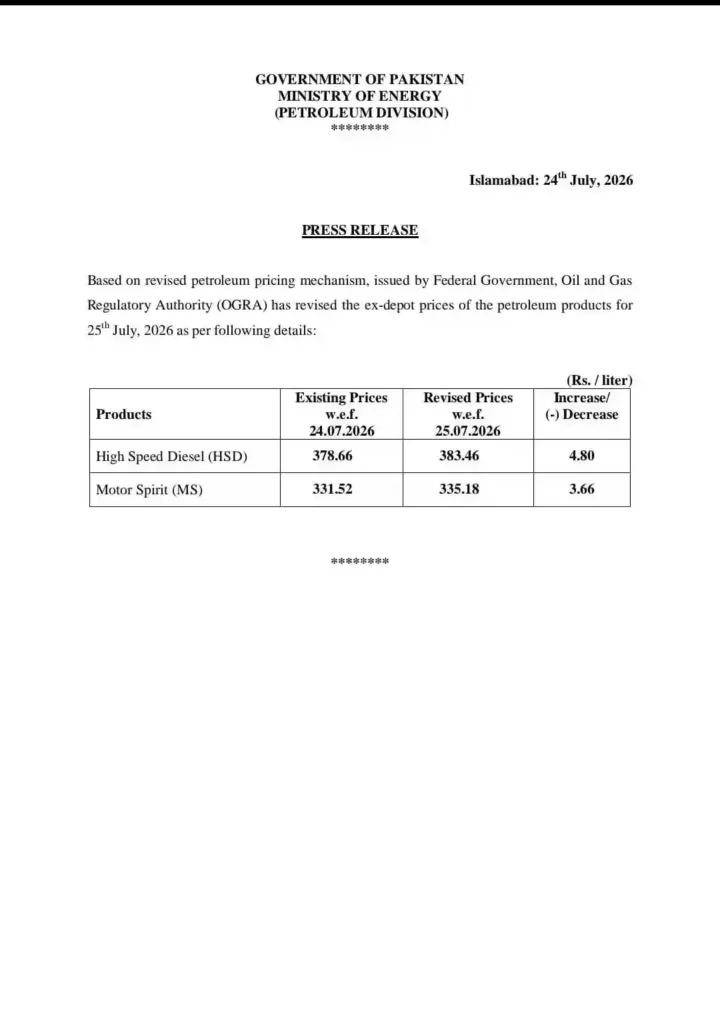
The revised fuel prices effective from 25 July 2026 are as follows:
| Petroleum Product | Previous Price (Rs./Litre) | New Price (Rs./Litre) | Increase |
|---|---|---|---|
| High-Speed Diesel (HSD) | Rs. 378.66 | Rs. 383.46 | Rs. 4.80 |
| Motor Spirit (Petrol) | Rs. 331.52 | Rs. 335.18 | Rs. 3.66 |
The government has officially increased the price of petrol by Rs. 3.66 per litre, while the price of diesel has been increased by Rs. 4.80 per litre.

Official Notification Issued by the Ministry of Energy
According to the official press release issued on 24 July 2026, the Government of Pakistan approved the revised ex-depot petroleum prices after recommendations submitted by OGRA.
The notification clearly states:
- Revised prices become effective from 25 July 2026
- Prices are revised under the Petroleum Pricing Mechanism
- The increase applies nationwide
- Petrol and High-Speed Diesel prices have both been revised upward
The official notification includes the following details:
- Motor Spirit (MS)
- Existing Price: Rs. 331.52
- Revised Price: Rs. 335.18
- Increase: Rs. 3.66
- High-Speed Diesel (HSD)
- Existing Price: Rs. 378.66
- Revised Price: Rs. 383.46
- Increase: Rs. 4.80

Why Have Petrol and Diesel Prices Increased?
The latest Pakistan Fuel Price Update reflects adjustments made under Pakistan’s petroleum pricing mechanism. Fuel prices are generally reviewed after considering several economic factors.
Some of the major reasons include:
- International crude oil prices
- Exchange rate fluctuations
- Import costs
- Freight charges
- Petroleum Levy
- Inland Freight Equalization Margin (IFEM)
- Government taxation policies
- Recommendations submitted by OGRA
These factors collectively determine the ex-depot prices announced every fortnight.

Impact on the General Public
The latest increase in petrol prices is expected to affect millions of citizens across Pakistan.
Private vehicle owners will now spend more on fuel, increasing monthly transportation expenses.
People who travel daily for work or education may also experience higher commuting costs.
Ride-hailing services may revise fares to compensate for increased fuel expenses.
Businesses that depend on transportation will also face higher operational costs.

Effect on Transport Sector
The transport sector is one of the biggest consumers of petroleum products.
Since High-Speed Diesel (HSD) powers:
- Heavy trucks
- Buses
- Public transport
- Cargo vehicles
- Construction machinery
the increase of Rs. 4.80 per litre may lead to:
- Increased freight charges
- Higher transportation costs
- Increased logistics expenses
- More expensive delivery services
These costs often pass on to consumers through higher prices of goods.
Impact on Food Prices
When diesel prices increase, transportation costs for agricultural products also rise.
Farmers transporting fruits, vegetables, wheat, rice, sugar, and other commodities may incur higher fuel expenses.
As transportation becomes more expensive, retail prices of essential food items may also increase.
This can contribute to inflation across various sectors.
Impact on Agriculture
Agriculture heavily relies on diesel-powered machinery.
The latest increase in High-Speed Diesel prices may affect:
- Tube wells
- Tractors
- Harvesters
- Agricultural generators
Farmers may experience higher cultivation costs, especially during harvesting and irrigation seasons.
Industrial Impact
Industries that rely on transportation and diesel-powered equipment could also experience increased operating expenses.
Higher logistics costs may affect:
- Manufacturing
- Cement sector
- Textile industry
- Construction projects
- Export businesses
Businesses may need to adjust operational budgets due to increased fuel costs.
How Often Are Fuel Prices Revised in Pakistan?
Pakistan generally revises petroleum prices every 15 days.
During each review, OGRA evaluates:
- International petroleum prices
- Exchange rate movements
- Import premiums
- Freight adjustments
- Applicable taxes and levies
After reviewing these factors, recommendations are submitted to the federal government, which announces the final prices through the Ministry of Energy (Petroleum Division).
What Is Motor Spirit (MS)?
Motor Spirit (MS) is the official term used for petrol in Pakistan.
It is commonly used in:
- Cars
- Motorcycles
- Rickshaws
- Small commercial vehicles
The revised Motor Spirit price has now increased to Rs. 335.18 per litre.
What Is High-Speed Diesel (HSD)?
High-Speed Diesel (HSD) is primarily used in heavy transportation and industrial machinery.
Major users include:
- Trucks
- Buses
- Tractors
- Heavy equipment
- Construction machinery
- Agricultural machinery
The new High-Speed Diesel price is Rs. 383.46 per litre.
Complete Summary of the Revised Fuel Prices
The latest Pakistan Fuel Price Update can be summarized as follows:
- Petrol Price
- Previous: Rs. 331.52
- New: Rs. 335.18
- Increase: Rs. 3.66
- Diesel Price
- Previous: Rs. 378.66
- New: Rs. 383.46
- Increase: Rs. 4.80
- Effective Date:
- 25 July 2026
- Notification Issued:
- 24 July 2026
- Issued By:
- Ministry of Energy (Petroleum Division)
- Recommended By:
- Oil and Gas Regulatory Authority (OGRA)
Notification Details
The official notification issued by the Government of Pakistan, Ministry of Energy (Petroleum Division) on 24 July 2026 confirms that the revised petroleum prices are applicable from 25 July 2026. According to the notification, the High-Speed Diesel (HSD) price has been revised from Rs. 378.66 to Rs. 383.46, showing an increase of Rs. 4.80 per litre. Similarly, the Motor Spirit (Petrol) price has increased from Rs. 331.52 to Rs. 335.18, reflecting an increase of Rs. 3.66 per litre. These revised ex-depot prices have been implemented under the government’s petroleum pricing mechanism following recommendations from OGRA.
Frequently Asked Questions
When will the new petrol prices take effect?
The revised petrol and diesel prices are effective from 25 July 2026.
How much has petrol increased?
The price of petrol has increased by Rs. 3.66 per litre.
How much has diesel increased?
The price of High-Speed Diesel (HSD) has increased by Rs. 4.80 per litre.
Who announced the new fuel prices?
The revised prices were announced by the Government of Pakistan through the Ministry of Energy (Petroleum Division) following recommendations from OGRA.
What is the new petrol price?
The new petrol price is Rs. 335.18 per litre.
What is the new diesel price?
The new High-Speed Diesel (HSD) price is Rs. 383.46 per litre.
Conclusion
The latest Pakistan Fuel Price Update brings another increase in fuel prices, with petrol rising by Rs. 3.66 per litre and High-Speed Diesel increasing by Rs. 4.80 per litre. The revised rates became effective from 25 July 2026 following the official notification issued by the Ministry of Energy (Petroleum Division) based on OGRA’s recommendations. As fuel costs rise, consumers, transporters, businesses, and farmers are likely to experience higher operating expenses, which may also influence transportation charges and the prices of essential goods in the coming weeks.