Punjab Government Plans Dedicated Bike Lanes on Major Roads in Lahore
Lahore’s traffic has long been a daily challenge for residents, with motorcyclists and cyclists often squeezed between cars, buses, and rickshaws on the same congested roads. In response, the Punjab Government bike lanes initiative has emerged as one of the most talked-about urban mobility plans in recent months. According to reports, Punjab Chief Minister Maryam Nawaz Sharif has ordered the designation of dedicated bike lanes on major roads in Lahore, signaling a potential shift in how the city approaches two-wheeler transport and traffic management.
This move is being seen as part of a broader effort to modernize Lahore’s road infrastructure while addressing rising concerns about accidents involving motorcyclists and cyclists.

Punjab Government’s Bike Lane Plan
The proposed plan for dedicated bike lanes in Lahore is reported to have been inspired partly by international models. According to media reports, the Chief Minister referenced cities such as Beijing, Nanjing, and Zhanjiang in China, where bike and scooter riders use lanes that are physically separated from main traffic corridors by wide sidewalks or dividers.
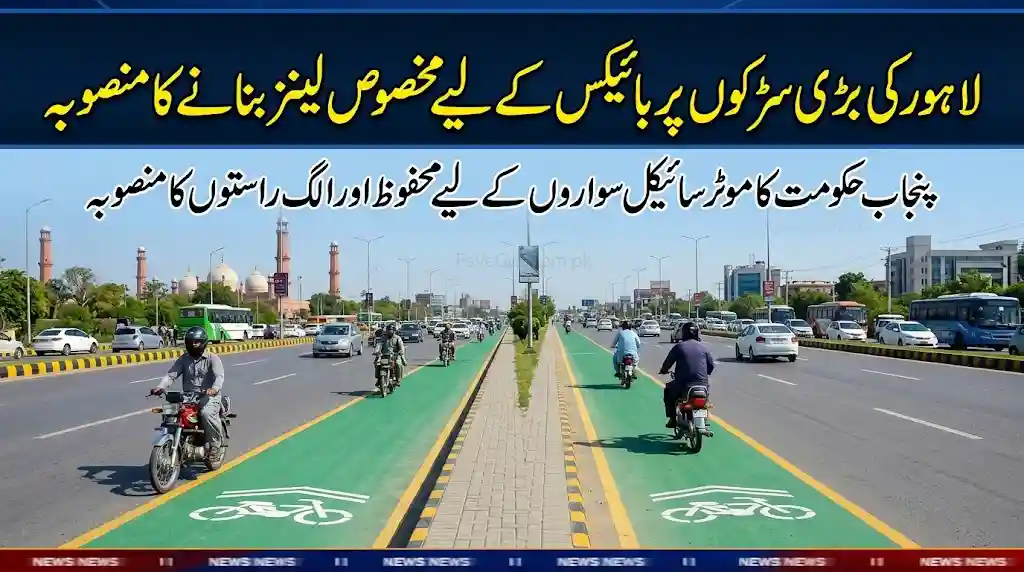
Officials associated with the Lahore Development Authority (LDA) and the City Traffic Police are reportedly working on feasibility studies and design plans to identify suitable roads for this initiative. Some reports indicate that a pilot phase is being developed along sections of Ferozepur Road, from Canal Road to Lahore Bridge, where lanes are said to be marked in green for better visibility. However, the full scope, timeline, and exact number of roads to be covered under the province-wide plan have not been officially confirmed, and details are expected to evolve as the project progresses.
A Response to Rising Road Safety Concerns
Reports suggest that a key motivation behind the Lahore bike lanes proposal is the high number of accidents and injuries involving two-wheeler riders. Officials have reportedly noted that head injuries among motorcyclists are a leading cause of fatalities and long-term disabilities on Lahore’s roads. Establishing dedicated lanes is seen as one way to reduce the risk that comes from sharing lanes with larger, faster vehicles.

Why Lahore Needs Dedicated Bike Lanes
Lahore’s roads carry an enormous mix of traffic every day, from cars and buses to motorcycles, bicycles, and increasingly, e-bikes. Without designated space, two-wheelers are often forced to weave between vehicles, increasing the likelihood of collisions.
Improving cycling infrastructure in Punjab is not just about convenience; it is also about creating safer, more predictable traffic patterns. When motorcyclists and cyclists have their own lane, drivers of cars and heavy vehicles can also enjoy smoother movement, since unpredictable lane-switching by two-wheelers is reduced.

Growing Demand for Affordable Transport
Rising fuel prices and transportation costs have made motorcycles and bicycles a practical choice for many Lahore residents. As more people turn to two-wheelers for daily commuting, the pressure on shared road space naturally increases, making the case for separate lanes even stronger.
Major Benefits for Cyclists and Commuters
If implemented effectively, dedicated lanes could offer several advantages for daily commuters across the city.
- Reduced risk of accidents caused by mixing with fast-moving traffic
- Smoother commutes for motorcyclists and cyclists without constant lane changes
- More predictable traffic flow for all road users, including car drivers
- Encouragement for a bike-friendly Lahore, where cycling becomes a more attractive option for short-distance travel
These benefits are particularly relevant for students, office workers, and small business owners who rely on motorcycles or bicycles for affordable daily transport.
Impact on Traffic and Road Safety
One of the primary goals behind this initiative, according to reports, is improving Lahore traffic management. By separating slower two-wheelers from faster four-wheeled traffic, authorities hope to reduce bottlenecks at busy intersections and along major corridors.
Enhancing Road Safety for Cyclists
Road safety for cyclists has become an increasingly important topic in Lahore’s urban planning conversations. Physically separated lanes, clear signage, and distinct road markings—such as the green paint reportedly used on parts of Ferozepur Road—are intended to make cyclists and motorcyclists more visible to other drivers, potentially reducing collisions at merging points and turns.
Authorities have also reportedly discussed complementary measures, such as pedestrian safety upgrades and stricter enforcement of traffic rules, as part of the same broader push to modernize Lahore’s roads.
Support for Bicycles and E-Bikes
As environmental awareness grows and fuel costs remain a concern, e-bike lanes in Lahore could play an important role in encouraging the shift toward electric two-wheelers. Dedicated infrastructure gives both traditional cyclists and e-bike users a safer space to travel, which may in turn boost adoption of these more affordable and eco-friendly commuting options.
If the plan expands as proposed, it could gradually reshape how residents view cycling and e-biking—not just as recreational activities, but as legitimate, everyday transportation choices for a bike-friendly Lahore.
Environmental and Economic Benefits
Beyond safety and convenience, dedicated bike lanes could contribute to broader environmental and economic goals. Encouraging more people to use bicycles and e-bikes instead of fuel-powered vehicles may help reduce emissions and traffic-related pollution over time.
Economically, promoting low-cost transportation options aligns with the needs of many commuters who are looking for affordable alternatives amid rising living costs. A well-planned cycling network could also reduce dependency on fuel imports in the long run, though such outcomes would depend heavily on how widely the infrastructure is adopted and maintained.
Challenges in Developing Bike Lanes
While the plan has generated optimism, experts and citizens have also pointed out potential challenges. Encroachments, inconsistent enforcement, and a general lack of awareness about lane discipline could limit the effectiveness of dedicated lanes if not addressed properly.
Some observers have also raised concerns about the design of physical barriers used to separate lanes, noting that poorly constructed dividers could pose their own safety risks to riders. Ensuring proper maintenance, clear signage, and public education campaigns will likely be necessary for the initiative to succeed in the long term.
What the Plan Could Mean for Lahore’s Future
If successfully implemented, this initiative could mark a turning point in how Lahore approaches urban transport planning. Expanding cycling infrastructure in Punjab beyond a pilot phase could set a precedent for other major cities in the province to adopt similar models.
Over time, this could contribute to a broader cultural shift—one where cycling and e-biking are viewed as safe, practical, and even preferred modes of transport for short urban commutes, rather than a last resort.
Punjab Government Bike Lanes Conclusion
The proposed Punjab Government bike lanes initiative reflects a growing recognition that Lahore’s roads need to accommodate more than just cars and heavy vehicles. While specific details such as final costs, exact completion timelines, and the full list of roads remain unconfirmed and subject to change, the direction of the plan points toward safer streets, better traffic flow, and more inclusive transport options for the city’s residents. As reports continue to emerge, residents and commuters alike will be watching closely to see how this vision for a more bike-friendly Lahore takes shape in the months ahead.