
OGRA Petrol Price Update 23 July 2026 – Check New Petrol & HSD Prices in Pakistan
The Government of Pakistan has officially announced a fresh revision in petroleum prices through the Ministry of Energy (Petroleum Division). According to the latest notification issued on 22 July 2026, the Oil and Gas Regulatory Authority (OGRA) has increased the ex-depot prices of both Motor Spirit (Petrol) and High-Speed Diesel (HSD) with effect from 23 July 2026. The new fuel prices have been implemented under the revised petroleum pricing mechanism introduced by the federal government.
The latest revision comes after fluctuations in international crude oil prices and changes in import premiums. As a result, consumers across Pakistan will now pay higher prices for both petrol and diesel at fuel stations nationwide. This update is expected to affect transportation costs, inflation, and the prices of essential goods in the coming days.
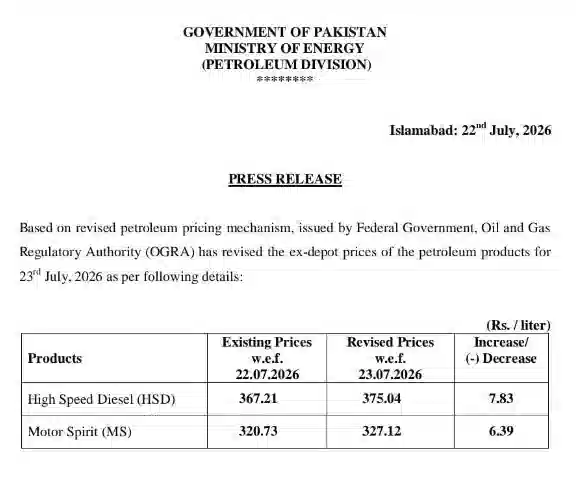
OGRA Petrol Price Update 23 July 2026
According to the official notification issued by the Petroleum Division, the revised ex-depot prices effective 23 July 2026 are as follows:
| Petroleum Product | Previous Price (Rs./Litre) | New Price (Rs./Litre) | Increase |
|---|---|---|---|
| Motor Spirit (Petrol) | 320.73 | 327.12 | Rs. 6.39 |
| High-Speed Diesel (HSD) | 367.21 | 375.04 | Rs. 7.83 |
The increase has been approved based on recommendations made by OGRA under the government’s revised petroleum pricing mechanism.

Official Petroleum Division Notification
The official press release issued by the Ministry of Energy states:
- Notification Date: 22 July 2026
- Effective Date: 23 July 2026
- Issued By: Government of Pakistan, Ministry of Energy (Petroleum Division)
- Regulator: Oil and Gas Regulatory Authority (OGRA)
According to the notification:
- High-Speed Diesel (HSD) increased from Rs. 367.21 to Rs. 375.04 per litre.
- Motor Spirit (Petrol) increased from Rs. 320.73 to Rs. 327.12 per litre.
These revised ex-depot prices became effective from 23 July 2026 across Pakistan.

Why Did Petrol Prices Increase?
The latest OGRA Petrol Price Update 23 July 2026 reflects movements in the international petroleum market. Several factors contributed to this increase, including:
- Rising global crude oil prices.
- Higher import premiums.
- Exchange rate fluctuations.
- Increased freight and supply chain costs.
- Adjustments under Pakistan’s revised daily petroleum pricing mechanism.
The government has stated that domestic fuel prices are linked to international market trends, meaning any significant increase or decrease in crude oil prices directly impacts local petroleum prices.

Impact of Higher Petrol Prices
The increase in petrol and diesel prices is expected to have a widespread impact on Pakistan’s economy.
Transportation Costs
Public transport operators, freight companies, ride-hailing services, and logistics businesses may increase fares to offset higher fuel expenses.
Inflation
Higher transportation costs often result in increased prices of food items, vegetables, groceries, construction materials, and other daily-use products.
Agriculture
Since High-Speed Diesel (HSD) powers tractors, tube wells, and agricultural machinery, the increase may raise farming costs and eventually affect food prices.
Industrial Sector
Factories and businesses using diesel-powered generators or transportation fleets may experience increased operating costs.

New Daily Petroleum Pricing Mechanism
Pakistan has recently shifted from periodic petroleum price revisions to a revised pricing mechanism that allows more frequent adjustments based on international oil market conditions.
The objective of this system is to:
- Reflect international fuel prices more quickly.
- Reduce market distortions.
- Improve transparency in fuel pricing.
- Minimize sudden price shocks over longer review periods.
Under this mechanism, OGRA calculates ex-depot prices using global petroleum prices, exchange rates, import costs, taxes, levies, and freight margins before forwarding recommendations to the federal government.
How OGRA Determines Petrol Prices
The Oil and Gas Regulatory Authority (OGRA) prepares petroleum pricing recommendations after evaluating several economic indicators.
These include:
- International crude oil prices.
- Finished petroleum product prices.
- Pakistan Rupee exchange rate.
- Inland Freight Equalization Margin (IFEM).
- Petroleum Levy.
- Customs duties.
- Distribution margins.
- Dealer commissions.
After completing this assessment, OGRA submits recommendations to the federal government, which issues the final notification through the Ministry of Energy.
Comparison with Previous Fuel Prices
Before the latest revision, consumers were paying:
- Petrol: Rs. 320.73 per litre
- High-Speed Diesel: Rs. 367.21 per litre
After the notification:
- Petrol: Rs. 327.12 per litre
- High-Speed Diesel: Rs. 375.04 per litre
This means motorists now have to pay:
- Rs. 6.39 more per litre for petrol.
- Rs. 7.83 more per litre for diesel.
How Much Extra Will Consumers Pay?
The increase may appear small on a per-litre basis, but it becomes significant over larger fuel purchases.
Petrol
- 20 litres = Rs. 127.80 extra
- 40 litres = Rs. 255.60 extra
- 50 litres = Rs. 319.50 extra
High-Speed Diesel
- 20 litres = Rs. 156.60 extra
- 40 litres = Rs. 313.20 extra
- 50 litres = Rs. 391.50 extra
For transport companies operating multiple vehicles, these additional costs can accumulate quickly.
Effect on Public Transport
Public transport operators often revise fares following increases in fuel prices. If diesel prices remain elevated, passengers may experience:
- Higher bus fares.
- Increased intercity transport charges.
- More expensive goods transportation.
- Higher ride-hailing service fares.
Transport associations generally review fare structures after official fuel price notifications.
Effect on Businesses
Businesses relying heavily on transportation and logistics are likely to experience higher operating costs.
Industries that may be affected include:
- Courier services.
- Food delivery companies.
- Manufacturing units.
- Construction firms.
- Agricultural businesses.
- Retail distribution networks.
Many companies eventually pass these increased expenses on to consumers through higher product prices.
Government’s Position
The federal government has maintained that petroleum prices are adjusted according to international market conditions and recommendations submitted by OGRA.
Officials have emphasized that Pakistan imports a significant portion of its petroleum products, making domestic fuel prices sensitive to global oil market fluctuations and exchange rate movements.
Should Consumers Expect More Changes?
Since Pakistan is now following a more dynamic pricing mechanism, fuel prices may continue to change depending on:
- International crude oil prices.
- Regional geopolitical developments.
- Exchange rate movements.
- Import costs.
- Shipping expenses.
- Government taxes and levies.
Consumers are therefore advised to monitor official OGRA notifications regularly.
Tips for Saving Fuel
During periods of rising petroleum prices, motorists can reduce fuel consumption by:
- Maintaining proper tyre pressure.
- Avoiding unnecessary acceleration.
- Keeping vehicles properly serviced.
- Planning routes efficiently.
- Reducing unnecessary trips.
- Using public transportation whenever possible.
- Switching off engines during long stops.
Even small improvements in fuel efficiency can help offset rising fuel costs.